

You want to transpose a song to a key you can sing. You need a starting point for figuring it out by ear. You want to match keys with someone you're playing with — knowing the key of a song makes everything after it easier. But how do you actually find that key?
There are three main ways to find the key of a song: ① spot it from the chord it resolves to (the tonic), ② narrow it down by matching the chords against a key's diatonic chords, or ③ detect it automatically from the audio with an app. The clue is always "which chord does it want to come home to?"
A key sets the central note (the tonic) of a song. That idea is covered in What is a key?. Here we focus on how to find it — three methods, in order.
Comparing the three methods
| Method | Speed | What you need | Best when |
|---|---|---|---|
| From the ending chord / tonic | Fast | Just one chord | You want a quick first guess |
| Narrow with diatonic chords | Medium | A few chords identified | You want to be sure |
| Detect with an app | Fast | Your own audio or playing | You want it fast and accurate |
① Spot it from the chord it resolves to (the tonic)
The easiest approach is to find the chord the song settles on. Most songs end on the tonic chord — the center of the key — so the last chord is a strong clue to what the key is.
For example, if a song comes to rest on C, the key is likely C major. If it lands wistfully on Am, A minor is a good bet. The chords at spots where an intro or a phrase feels like it "came home" are the same kind of clue.
The weakness: there are exceptions. Some songs deliberately end on a chord other than the tonic, and fade-outs can blur the resolution. So treat this as a way to guess; to confirm, combine it with ② below.
② Narrow it down with the key's diatonic chords
Every key has a set of seven chords that form its foundation. These are called the diatonic chords. Once you know the diatonic chords, you can see "a song in this key is built from these seven" — so, going the other way, if you list the chords in a song and look for the key whose seven they all fit neatly into, you've found the key.
For example, if a song uses C, F, G, and Am, the key that contains all four is C major (= A minor). G, C, D, Em points to G major, and so on. The key you guessed in ① can be confirmed in ② by checking whether every chord really fits.
This idea — "knowing the diatonic chords shows you the seven that form a key's foundation" — is explained in What are diatonic chords?. Learning diatonic chords also sharpens your ear (The science of ear training).
③ Detect it automatically from the audio
This method analyzes the audio itself and identifies the key along with the chords. When you're working with your own audio or your own playing, it solves the slowness of doing ① and ② by hand — you get the key and the chords at once.
Here's how to do that automatic detection in OtoTheory (iOS app).
The fastest way is "detect with an app" — the OtoTheory steps
OtoTheory's chord detection (Get Chords) is an iPhone and iPad feature that detects the actual chords from audio. It identifies the key at the same time. Analysis runs entirely on your device, and your audio is never uploaded anywhere.
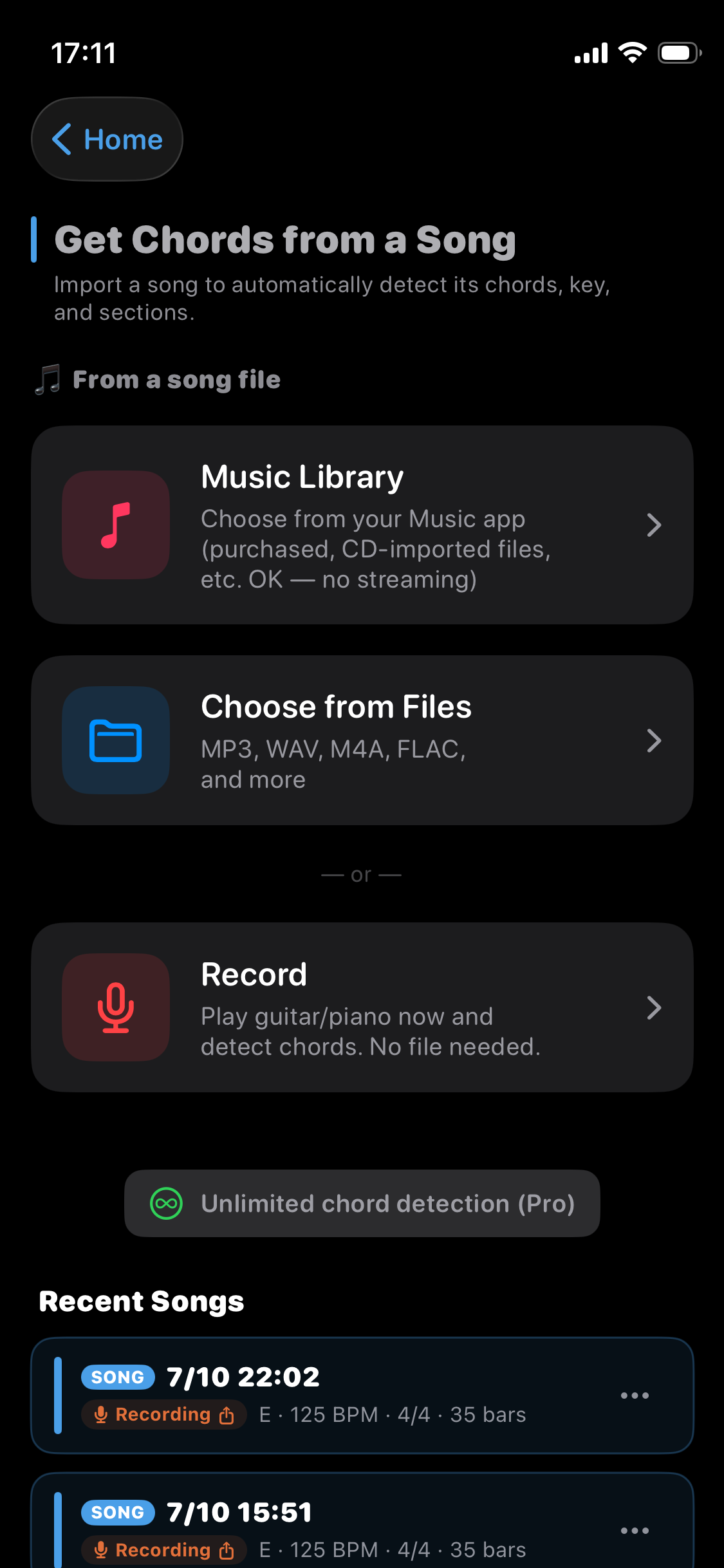
Step 1: Bring in a song
- Import a song you have: choose a purchased track, a CD rip, or your own audio file.
- Record your own playing: play guitar or piano on the spot. It works for singing and playing too.
Step 2: Get the key and chords automatically
Choose the audio (or finish recording) and on-device analysis begins. In a few dozen seconds, the key, chord progression, and sections appear. The key is shown on screen as something like "C major" — that's the answer you were looking for.
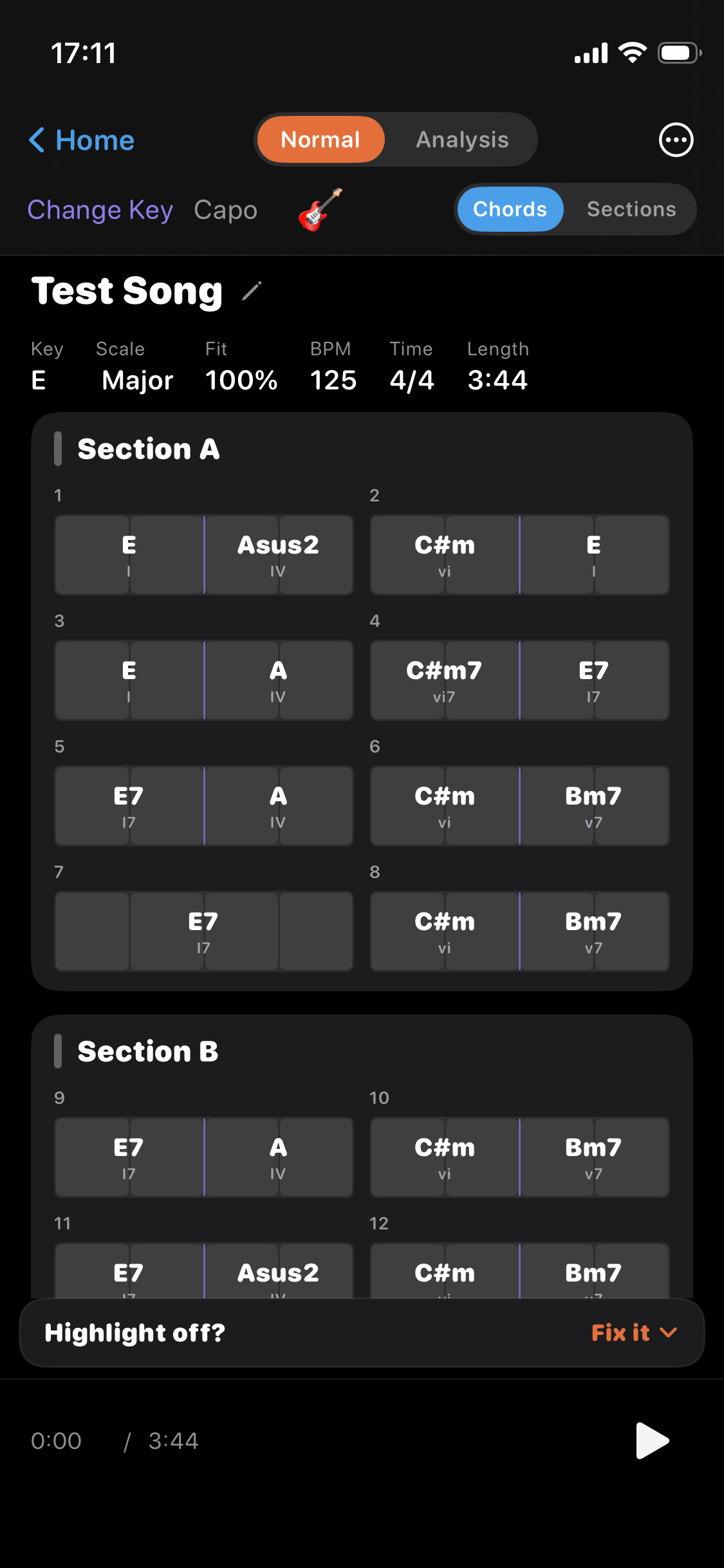
Step 3: Check it while playing back
You can play back the detected chords and check them by ear. Listening to whether the shown key agrees with the "tonic / diatonic" thinking from ① and ② lets you confirm it with confidence. For spots that don't quite fit, you can re-enter chords or tap along to the beat.
Once you know the key, here's what you can do
The key isn't so much a goal as a key to what's next. Once you have it:
- Transpose: send it to Create mode and shift the whole progression to a key that's easier to sing (moving up or down for your range or a bandmate is easy). Note: in the Play screen, "Change Key" switches the key interpretation (how the theory is read), not the chords themselves.
- See the chords that fit: with the key set, you know the diatonic chords (the seven that form the key's foundation), which narrows your ear-training candidates fast.
- Read it with theory: each chord gets its degree and function automatically, so you can see why a progression feels good.
- Send it to Create mode: use the key and progression you found as a base, then swap and add chords to grow it into your own song. Playing it back with a groove is a Create-mode feature too.
When it doesn't work
Finding a key doesn't always resolve cleanly. The common snags:
- Mixing up major and minor: C major and A minor are relative keys that share the same seven notes. The chords alone won't decide it, and listeners can genuinely interpret it differently. A common rule of thumb is to judge by which chord it settles on (settling on C leans major, on Am leans minor).
- Modulation or borrowing: a song that suddenly brightens at the chorus may have changed key (modulation) or be borrowing a chord from another key. Treat sections that one key can't explain separately.
- Some songs are ambiguous: a key is as much a framework for interpreting a song as a single "correct answer." OtoTheory's analysis shows how well each key and scale fits, as a percentage. Because there's no single right answer, you can use that analysis as a reference and interpret the key yourself. When in doubt, confirm from both ① the resolving chord and ② the chords used.
Frequently asked questions
Can I find the key from the last chord?Often, yes. Most songs end on the tonic — the center of the key — so the final chord is a strong clue. There are exceptions, so confirm by checking that all the chords used fit that key's diatonic chords.
How do I tell major from minor?There's no absolute right answer — the same song can strike one listener as major and another as minor, and opinions genuinely differ. As a general rule of thumb, a bright, open feel is usually heard as major and a dark, wistful feel as minor. For keys that share the same notes (relative keys, like C major and A minor), people commonly decide by which chord the song settles on — settling on C leans major, on Am leans minor. When you're unsure, it's worth checking OtoTheory's analysis (which shows key/scale fit as a percentage) and interpreting it your own way.
Can I find the key without knowing music theory?Yes. With OtoTheory's chord detection, the key is shown automatically from your own audio or playing. You can learn the key before you know any theory, then start practicing or writing from there.
Can the key change partway through a song?Yes. Modulation (the key switches) and borrowing (temporarily using a chord from another key) are common — a chorus that suddenly brightens is a classic case. If a section can't be explained by one key, suspect a modulation and treat that part separately.
Can I find the key from the chord progression alone?Usually, yes. List the chords in the song and look for the key whose diatonic chords they all fit. Tell major from minor by which chord the song resolves to (how it cadences).
Try it on iPhone or iPad
Automatic key detection is part of OtoTheory's chord detection (iOS app). From a song you have or your own playing, find the key, chords, and sections on the spot.
Related guides
- What is a key? — the role the center note (tonic) plays in a song
- What are diatonic chords? — how a key's foundational seven chords come from the key
- The science of ear training — finding chords and keys with theory
- How to find the chords of a song — get the chords along with the key
📖 References
The following sources were used in writing this article. (※ To be finalized before publish.)
Finding the key of a song and music theory* How to Find the Key of a Song – musictheory.net — pinning down a key from the resolving chord and diatonic chords
* Key (music) – Wikipedia) — definitions of key, tonic, and relative keys
Up next: a guide on how to choose the next chord in a progression.